The Only Place I Still Get Imposter Syndrome
I don’t get imposter syndrome about my work anymore, but I still get it standing in a gravel parking lot at a trailhead I’ve never used, looking at a map and wondering whether I’m actually the person who can do this today. It’s the same feeling I used to have at a desk, and it has migrated to the one part of my life that has nothing to do with my job. It isn’t that consulting made me more confident, it’s that consulting changed who chooses the work.
When someone else picked the work
As a new cloud engineer it was constant, because in those days you became the cloud person for the thinnest of reasons, usually that you had touched AWS slightly more recently than anyone else in the room. That was enough to put me in architecture reviews where everyone assumed I had firm opinions about VPC routing and IAM policy while I was still working out why a subnet refused to route and what a NAT gateway was quietly costing us, and AWS kept shipping new services faster than any of us could read about them.
Nobody involved in that decision asked whether it played to anything you were actually good at, which isn’t malice so much as how staffing works. The org chart hands out problems, and the fit between the problem and the person it lands on is mostly luck or bad luck.
Certifications turned out to be a shortcut into that feeling rather than a way out of it. I passed my first AWS certification in 2014, and what it proved was that I could answer sixty five questions about a service on a Tuesday morning, which is a different thing from fixing a production fire. Every certification after it arrived with the same quiet asterisk attached, that I had passed the test without having proven anything to anybody yet, and collecting more of them widens the gap rather than closing it, because each one raises what people in the room expect of you before you have had the chance to earn it. Where certifications land probably depends on when in your career you go after them. Someone who sits the exam after years of running the thing in production is confirming what they already know, which is a very different experience from collecting the badge first and hoping the experience shows up behind it.
Consulting changed the input
Every engagement now starts with a scoping conversation, and that conversation is a filter running in both directions, because while the client is deciding whether to hire me, I’m deciding whether this is work I can do well. The second half of that is the part that changed everything.
The rule I use is simple, and it’s that if I can’t describe the first two weeks in concrete terms, what I’d look at, what I’d measure, where I expect it to go wrong, then it isn’t my engagement. Sometimes that means referring it to someone better suited, and sometimes it just means saying no.
That is the whole mechanism, and it’s less flattering than it sounds. I’m not calm about client work due to age, I’m calm because I stopped receiving problems from an org chart and started choosing them, which makes the confidence a selection effect I built on purpose rather than a personality trait.
Choosing the work is not avoiding the unknown
This is where people hear something I don’t mean, so I’ll be clear that picking work you’ll be good at is not the same as only doing what you’ve already done. The difference matters, because one of those is a filter and the other is a cage.
Every engagement has unknowns in it, since I’ve never seen your data, your schema is going to surprise me, and there’s a service in your pipeline that exactly one person understood before they left in March. That’s all normal, and none of it produces the imposter feeling.
The real difference is between not knowing the specifics and not knowing the domain, and on day one of a relevance project I have no idea why your ranking is bad while having a very clear idea of how to find out. What transfers between engagements is method rather than familiarity, and once you’ve noticed that, the unfamiliar parts stop reading as evidence against you.
There’s also a quieter thing that happens with experience, which is that the better you know a domain, the more precisely you can see the shape of what you don’t know inside it. It’s the old circle analogy, where everything you know sits inside the circle and the boundary is where it meets everything you don’t. Learn more and you draw a bigger circle, but the boundary gets longer too, so the amount of ignorance you can actually see grows right along with the knowledge. That kind of bounded, legible ignorance feels nothing like being an imposter, because it feels like a list of things to go find out.
What it costs
If you only take work you’re already good at, you don’t get to grow on a client’s budget. I think that’s the correct call because a client isn’t paying you to learn, and it does mean the growing has to happen somewhere else.
For me that somewhere else is open source, where Apache OpenNLP, the OpenSearch projects I work on, and the redaction tools I build at Philterd are where I get to work on things I don’t already understand. Open source is a good place to learn because nobody is being billed while you figure it out, and a first attempt that misses gets reviewed by people who know the code better than you do.
The trailhead
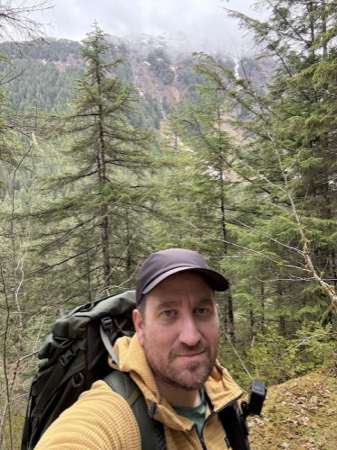
The strongest imposter feeling I get these days comes at the start of a hike in country I don’t know, on a route I’ve only seen as a line on a map. Then I walk, and it’s fine, not in the sense of easy but in the sense that it’s the same thing I’ve done many times in different terrain, and my legs and my judgment both work the way they always have. The doubt was never a measurement of what I could do, it was a reaction to unfamiliarity, and some part of my brain insists on filing unfamiliar under incapable.
I see the same thing in other people when I’m guiding with Deliberate Pace Guiding, where it lives at the trailhead and almost nowhere else. Nobody is having an existential conversation about whether they belong out there once they’re forty minutes in and settled into a rhythm, because by then they’re just walking.
The tell
That’s the pattern worth taking home from all of this, that imposter syndrome is an anticipation problem rather than an accuracy problem. It shows up before you start, it’s loudest when the thing in front of you is unfamiliar rather than genuinely hard, and it dissolves once you’re moving, because moving replaces the question of whether you can do this with the question of what comes next.
So the fix isn’t a pep talk for a consultant, it’s choosing engagements you can actually describe before you start. Everywhere outside of work it’s starting anyway, and then noticing afterward that the version of you standing in the parking lot was wrong.
If you’ve got a search, NLP, or cloud problem and you want to know whether it’s something I can help with, get in touch. Part of that first conversation is me telling you if it isn’t.